
What Changed in AD 70?
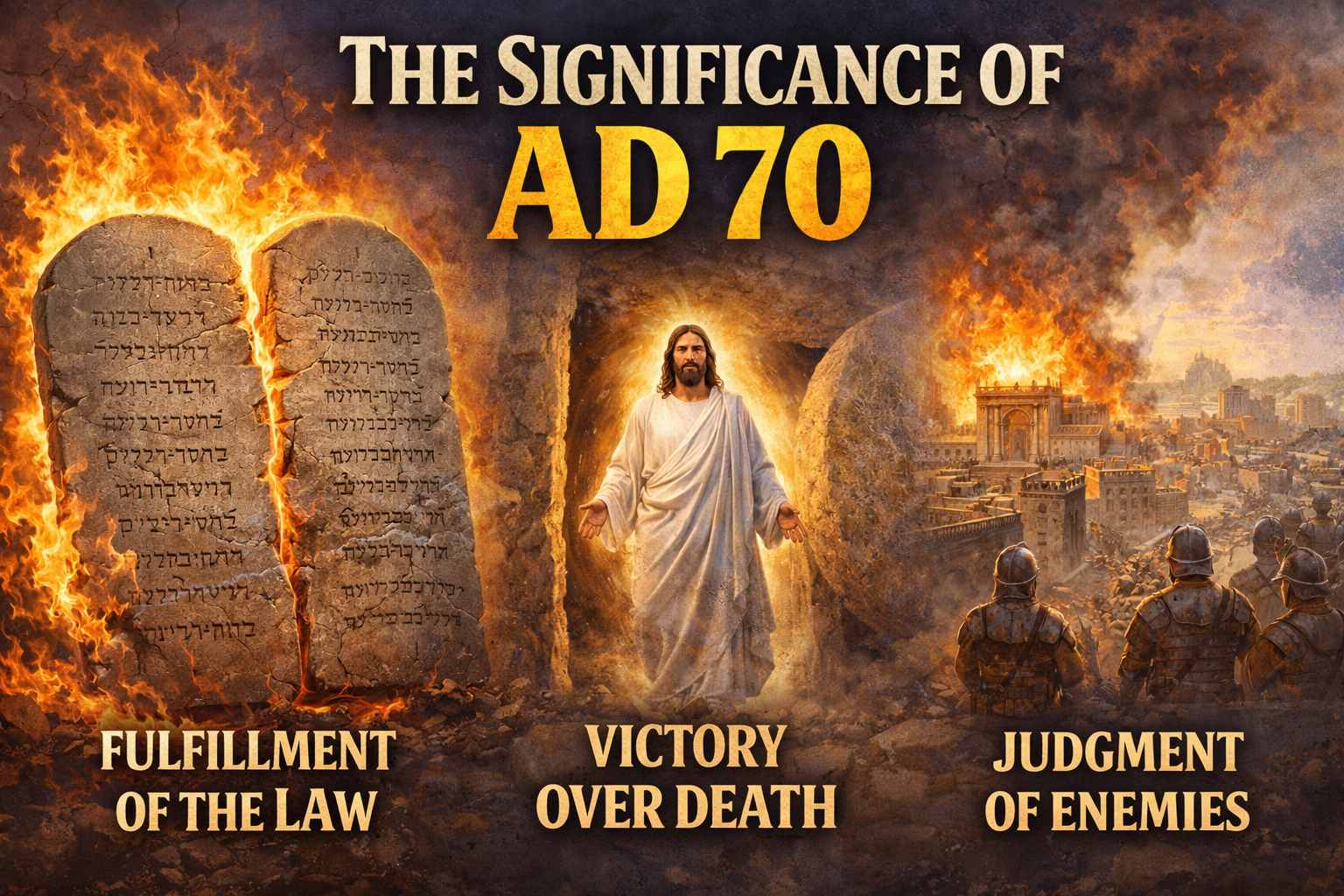
Opponents of preterism[1] often claim that nothing substantial changed in AD 70. But nothing could be further from the truth!
First, the fulfillment of Jesus’ prophecy of the destruction of the temple and city of Jerusalem within the “this generation” timeframe stated in the Olivet Discourse (see Luke 21:5-32) proved Jesus was who he claimed to be, the Son of God. This temple had been standing for around five hundred years, and it had just been refurbished by Herod the Great. It was so magnificent that the prominent Jews in that day said it would stand forever![2] And the city of Jerusalem was surrounded by what was thought to be an impenetrable wall. Yet the temple/city went tumbling down, just like Jesus had prophesied.
While the miracles Jesus performed in the days of his flesh certainly attested to his divinity to his fellow countrymen, the destruction of the temple/Jerusalem was the exclamation point on it. Moreover, this judgment testified—and still testifies today—to those outside Judea that Jesus is exactly who he claimed to be.
Second, since Jesus’ prophecy of the destruction of the temple/Jerusalem came to pass exactly as stated, we have excellent reason to trust Jesus when it comes to untestable things, such as, “Whover lives and believes in me will never die” (John 11:26).
Third, Jesus coming on clouds of judgment in AD 70—along with his resurrection—affirmed to his first-century disciples that they had put their faith in the right person. It showed that God was on Jesus’ side, rather than Jewish establishment who pierced him.[3]
Fourth, the judgment in AD 70 gave relief to the Christians who were being persecuted by the Jewish establishment.[4] The head of the persecuting snake, Jerusalem, was cut off.
Fifth, the destruction of the temple in AD 70 was the “sign”[5] that the Old Covenant age had officially ended and that the related rituals and sacrifices—such as physical circumcision, Sabbath keeping, feast day observances, and dietary requirements—were officially defunct.
Sixth, the destruction of the temple in AD 70 meant (1) that the Old Covenant “ministry of death”[6]—which could not take away sin[7]—had officially ended…and (2) that the New Covenant ministry of forgiveness of sin and everlasting life had officially begun in earnest. The death, which had begun way back in the garden of Eden on the day Adam and Eve ate the forbidden fruit,[8] was finally overcome by Jesus…hence, there are “no more tears.”
Seventh, the Old Testament saints who had died prior to Jesus atoning for sin—who were awaiting their Savior in Hades[9]—were finally released/resurrected out of Hades and allowed into heaven. From that point forward, believers who die go directly to heaven…hence, there are “no more tears.”
Those who try to diminish the importance of AD 70 have just not grasped the magnitude of what Jesus accomplished. These events were immensely significance, not only for Israelites in the first century, but for every child of God before and after.
For more information about the significance of the events in AD 70, please see my book The End Is Here: How the New Testament Prophesies Were Fulfilled, available NOW on Amazon!
By Alex Polyak, director of The Bible Fulfilled, 3/27/26.
[1] Preterists believe the Second Coming happened in the first century based on Jesus saying to his first-century audience, “For the Son of Man will come in the glory of His Father with His angels, and then He will reward each according to his works. Assuredly, I say to you, there are some standing here who shall not taste death till they see the Son of Man coming in His kingdom” (Matt. 16:27-28; see also Matt. 10:23, 24:30–34, 26:64; Phil. 4:5; Heb. 10:37; James 5:8; and Rev. 22:7, 12, 20),
[2] “The temple has for its revenues not only portions of land, but also other possessions of much greater extent and importance, which will never be destroyed or diminished; for as long as the race of mankind shall last, the revenues likewise of the temple will always be preserved, being coeval in their duration with the universal world” (Philo Judaeus, The Works of Philo Judaeus: Volume 2, The Special Laws, 1:14.)
[3] Technically the Romans crucified Jesus, but they did it at the behest of the Jewish establishment (see Luke 23:21, John 1:11).
[4] This Jewish persecution of Christians is documented all throughout the book of Acts (see Acts 4:3-22, 5:17-42, 6:8-8:1, 8:3, 9:2, 9:23-24, 12:1-5, 13:44-51, 14:5-6, 14:19-20, 16:16-24, 17:1-15, 18:12-17, 19:23-41, 20:19, 21:27-28:30).
[5] Matthew 24:3 – “Now as He sat on the Mount of Olives, the disciples came to Him privately, saying, ‘Tell us, when will these things be? And what will be the sign of Your coming, and of the end of the age?’”
Hebrews 9:8-9 – “The way into the Holiest of All was not yet made manifest while the first tabernacle was still standing. It was symbolic for the present time in which both gifts and sacrifices are offered which cannot make him who performed the service perfect in regard to the conscience.”
[6] 2 Corinthians 3:7 – “But if the ministry of death, written and engraved on stones, was glorious, so that the children of Israel could not look steadily at the face of Moses because of the glory of his countenance, which glory was passing away, 8 how will the ministry of the Spirit not be more glorious?”
[7] Hebrews 10:4 – “For it is not possible that the blood of bulls and goats could take away sins.”
[8] The kind of death that Adam and Eve introduced into the world was spiritual death, not physical death. Back in the garden of Eden, God had warned Adam and Eve, “In the day you eat from the tree of the knowledge of good and evil, you shall surely die” (Gen. 2:17). Yet after eating, Adam lived to 930 years (Genesis 5). Adam and Eve even had children afterwards (Gen. 4:25). So their punishment was obviously not physical death; it was spiritual death, aka separation from God. They were immediately kicked out of the garden, lost access to the tree of life, and lost their face-to-face relationship with God. But Jesus restored this broken relationship—and overcame this death/separation—by sacrificing himself on the cross and atoning for sin (see Heb. 9:26-28).
[9] 1 Corinthians 15:55-57 – “‘O Death, where is your sting? O Hades, where is your victory?’ The sting of death is sin, and the strength of sin is the law. But thanks be to God, who gives us the victory [over sin, death, and Hades] through our Lord Jesus Christ.”
Revelation 20:13-14 – “The sea gave up the dead who were in it, and Death and Hades delivered up the dead who were in them. And they were judged, each one according to his works. Then Death and Hades were cast into the lake of fire.”