
Can the Olivet Discourse be Divided? (Part Two)
In Part One of this article, I showed that Matthew 24’s account of the Olivet Discourse cannot be divided based on the questions in verse 3. In Part Two, I will show that it cannot be divided between verses 34 and 35 either.
Futurists[1] sometimes try to get around Jesus’s plain teaching in the Olivet Discourse—in which he said he would come again on clouds of glory within his generation (Matt. 24:30-34)—by dividing up the discourse into two sections. They admit Matthew 24:1–34 refers to Jesus’s coming in AD 70, however, they claim verses 35 onward—in which Jesus talks about “the passing of heaven and earth” and “nobody knowing the day or hour”—refer to another coming which still has not happened two thousand years later.
But this division doesn’t work for a host of reasons.
First, as stated in Part One, neither Jesus nor Matthew said anything about two different comings anywhere in the context of Matthew 24. Had they had two different comings in mind—separated by more than two thousand years—surely one of them would have said something to that effect. Yet they didn’t.
Second, the same “partial preterists” who say Matthew 24 refers to two comings (vv. 1–34, vv. 35–51) readily acknowledge that Luke 17:20–37 refers to events that happened in the first century. But the problem for partial preterists is that when we compare the various elements listed in these two passages, we see that some of the elements of Luke 17—which partial preterists admit is AD 70—are mentioned in the supposed post–AD 70 section of Matthew 24. Consider the following chart:[2]
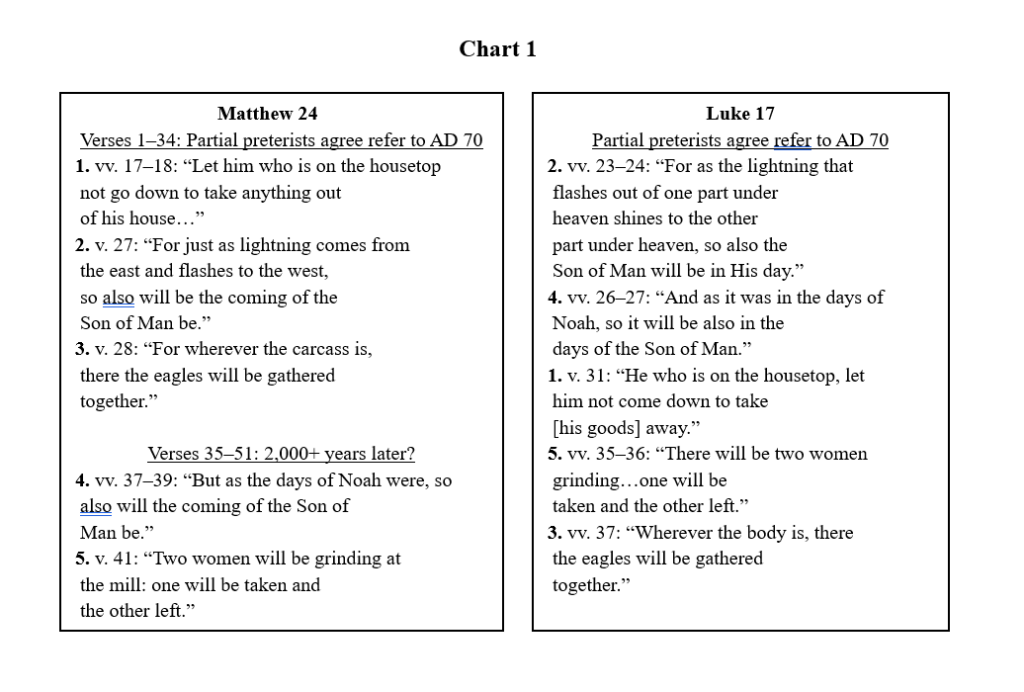
Either the entirety of Matthew 24 refers to AD 70—just like Luke 17—or one of these accounts is mistaken!
Third, we know Jesus was referring to the same coming all throughout Matthew 24 because he used the same Greek word “parousia” (“coming”) in both parts of the chapter. As the following chart shows, Jesus used it twice in the first half of the chapter (verses 3 and 27) and twice in the latter part (verses 37 and 39).
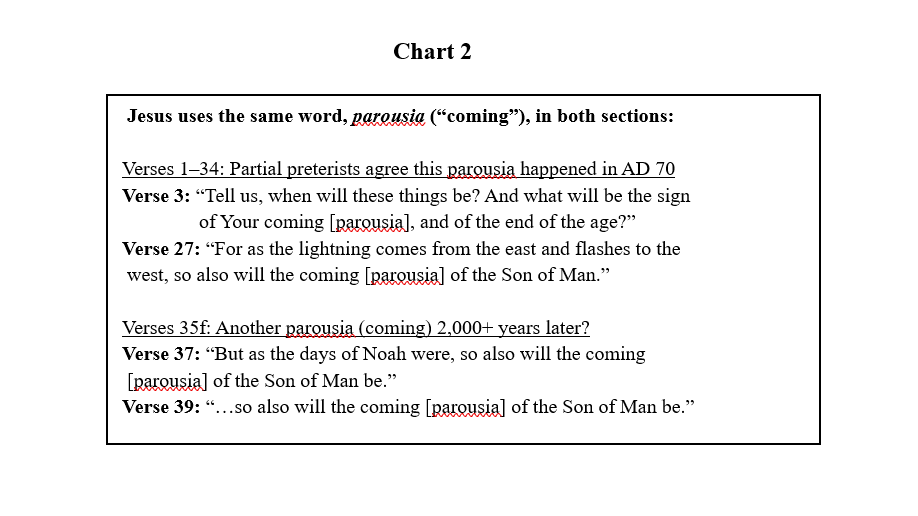
Had Jesus been referring to two different comings in these passages, wouldn’t he or Matthew have used a different word to describe them (if not said something to that effect to prevent confusion)? I think they would have.
Fourth, another reason why Matthew 24 cannot be divided is that Jesus is addressing the same group of people, his first-century disciples, throughout the entire discourse! The pronouns “you” and “your” make this abundantly clear. For example, Jesus says:
“Do you [disciples] not see these things [temple stones]? Assuredly, I say to you, not one stone shall be left here upon another that shall not be thrown down?” (24:2).
“Take heed that nobody deceives you” (24:4)…“They will deliver you up to tribulation” (24:9).
“Pray that your flight may not be in winter” (24:20).
“Then if anyone says to you, ‘Look, here is the Christ!’ or ‘There!’ do not believe it (24:23).
“When you see all these things, know that it is near—at the door” (24:33).
“Watch, therefore, for you do not know what hour the Lord is coming” (24:42).
“Assuredly, I say to you that he will make him ruler over all his goods” (24:47).
Jesus is addressing the same first-century disciples throughout the entire discourse. There is not even a hint of an audience change. And Jesus said these people would witness the events!
Fifth, after Jesus described in the first section the precursors to the second coming—such as false messiahs, wars and rumors of wars, famine, earthquakes, the abomination of desolation, and the great tribulation (vv. 1–34)—Jesus then reminds the disciples in the second section to “watch” for them (v. 42), for the second coming would happen immediately afterwards (v. 29). Jesus is obviously talking about the same events in both sections.
These five points prove the Olivet Discourse cannot be divided at v. 34. It is clearly about one (second) coming, and that one coming happened within Jesus’s generation, in AD 70.
Common Objections
Objection 1: Jesus said nobody knows the day or hour of his second coming.
Response: It’s true that nobody knew the day or hour of Jesus’ coming, but Jesus and the apostles sure knew it would happen within their generation because they said so over and over and over. For example, Jesus told his first-century audience:
“For the Son of Man will come in the glory of His Father with His angels, and then He will reward each according to his works. Assuredly, I say to you, there are some standing here who shall not taste death [die] till they see the Son of Man coming in His kingdom” (Matt. 16:27-28; see also Matt. 10:23, 24:30–34, 26:64; Phil. 4:5; Heb. 10:37; James 5:8; and Rev. 22:7,12, 20).
For more information about this topic, please see my article “Nobody Knows the Day and Hour?”
Objection 2: Jesus said heaven and earth will one day pass away.
Response: First, if “heaven and earth” has still not passed away, then that means every single part of the old covenant/the Law must still be kept…including the Sabbath, physical circumcision, dietary restrictions, feast day observances, and everything else. After all, Jesus said:
“For assuredly, I say to you, till heaven and earth pass away, one jot or one title will by no means pass from the law till all is fulfilled” (Matt. 5:18).
Not the smallest “jot or tittle” (part) of the old covenant could pass away until “heaven and earth” passed away. Therefore, unless heaven and earth has passed away, God’s people are still under the old covenant and all the requirements.
Moreover, the writer of Hebrews said in in approximately AD 62 that the old covenant was about to pass away:
“In that He says, ‘A new covenant,’ He has made the first [covenant] obsolete. Now what is becoming obsolete and growing old is ready to vanish away” (Heb. 8:13).
So if the old covenant passed away—and it has, per Hebrews—then “heaven and earth” must have passed away too, per Jesus.
Second, the term “heaven and earth” is a Hebraism (Jewish expression) that refers to God’s method (“heaven”) of relating/dealing with his people (“earth”). And what method was God using to relate to his people when Jesus said heaven and earth will pass away (Matt. 24:35)? The old covenant. This was the “heaven and earth” that Jesus said, in AD 33, would pass away within his generation (vv. 34–35), and this was the “heaven and earth” that did in fact pass away when the temple was destroyed in AD 70.
The temple symbolized the old covenant age (Heb. 9:8-9), and when the temple was destroyed, it meant the old covenant “heaven and earth” had officially passed away. Since that time, God has been relating to his people through a new method/system called the new covenant, aka: the “new heaven and earth.” And the new heaven and earth will never pass away (see Matt. 24:35, Heb 13:20, Jer. 32:40, and Isa. 61:8).
For more information about the passing of heaven and earth, please see my article “The Passing of Heaven and Earth.”
Or, for more detailed information about the topics discussed in this article, please check out my book The End Is Here: How the New Testament’s Prophecies Were Fulfilled, available NOW on Amazon.
By Alex Polyak, director of The Bible Fulfilled, 9/7/26.
[1] A futurist is someone who believes the Second Coming is a future event.
[2] Charles Meek, Christian Hope through Fulfilled Prophecy (Spicewood, TX: Faith Facts Publishing, 2013), 102.