
What is Preterism?
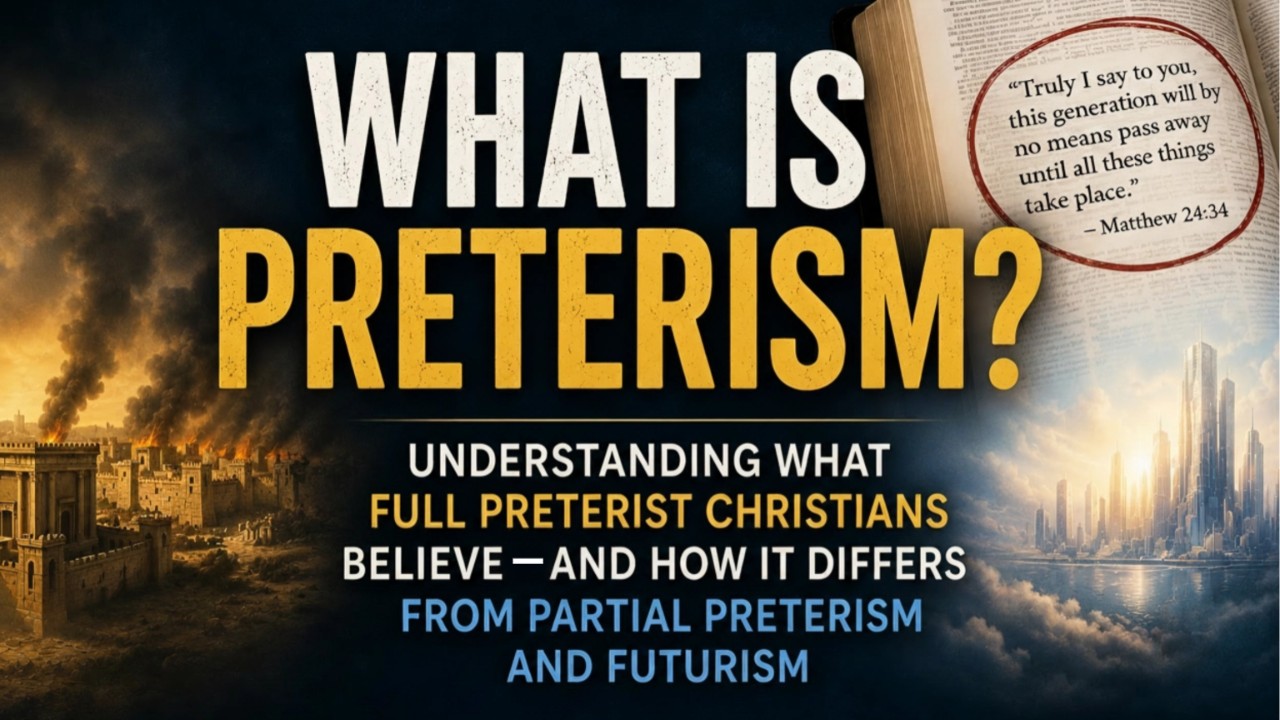
The term preterism basically just means “past.” It comes from the Latin word preteritus, which means “past” or “gone by.” So preterists are Christians who believes that the prophecies of the Bible have been fulfilled.
There are two kinds of preterists: partial preterists and full preterists.
Partial Preterists
Partial preterists believe some of the prophecies of the Bible have been fulfilled and some still need to be fulfilled. Technically, all Christians except full preterists are partial preterists because all Christians except full preterists believe some prophecies have already been fulfilled, and some still need to be fulfilled.
For example, partial preterists acknowledge that Herod’s Temple, which Jesus prophesied would be destroyed within a generation (Luke 21:5-32), was destroyed in the year AD 70. However, partial preterists believe there are other prophecies that still need to be fulfilled, such as the second coming, resurrection, and end-of-the-age judgment.
Full Preterists
Full preterists (aka preterists[1]), on the other hand, believe that all of the Bible’s prophecies have been fulfilled—including the second coming, the general resurrection, and the end-of-the-age judgment.
Keep in mind, just because full preterists believe the New Testament’s prophecies have been fulfilled does not mean they think the Bible is therefore irrelevant.[2] Full preterists view the fulfillment of the New Testament’s prophecies (such as the second coming, resurrection, and judgment) in the same way many Christians view the fulfillment of the Old Testament’s prophecies (such as the first coming of Messiah). That is, even though the prophecies were fulfilled, the books are still highly relevant. They confirm God’s existence. They show how God worked through history. They show God’s faithfulness (that he does what he says when he says he will do it). They reveal God’s wishes for humanity. And they teach moral truths. Such things will always be relevant to humanity.
Preterism and the Book of Revelation
Here’s where it can get confusing. As stated above, full preterist often call themselves preterists (for short)—which is same label partial preterists use for themselves when it comes to the book of Revelation. The reason partial preterists call themselves preterists (when it comes to the book of Revelation) is to distinguish themselves from futurists.
What’s the difference between preterists and a futurists when it comes the book of Revelation? Preterists believe that most of Revelation, though not all, has been fulfilled. Preterists usually say chapters 1-20 have been fulfilled, but chapter 21-22 still needs to be fulfilled. Keep in mind, there is some variation among preterists as to which parts are fulfilled.
Futurists, on the other hand, hold that almost the entire book of Revelation still needs to be fulfilled. Futurists usually say that only the first few chapters have been fulfilled, and the rest is still future. Keep in mind, there is some variation among futurists as to what is past and future.
So when it comes to the book of Revelation, a preterist believes that most of the book has been fulfilled, while a futurist believes most of the book is still future. Yet when it comes to eschatology in general, a preterist usually refers to a full preterist; and full preterists believe that all prophecy—including in the book of Revelation—has been fulfilled.
The Growth of Full Preterism
There is evidence that full preterism is growing. It seems like just about every week, a new preterist book or website or Youtube channel pops up.
There are also many well-known partial preterists and futurists writing books and making videos against full preterism, which shows that they are worried about it. There are even entire websites and ministries solely dedicated to trying to refute full preterism, which shows that the movement is growing.
One of the reasons full preterism is growing is because it directly takes on the most frequently cited objection to Christianity, which is that Jesus failed to do what he and his apostles prophesied.
Anyone who has studied the New Testament knows about the numerous timing indicators about the second coming, resurrection, and end-of-the-age judgment, in which Jesus and the apostles said these things would happen in their generation. These “time statements” can be found on just about every page of the New Testament, and they all say the exact same thing, which that these events would happen within the lifetimes of the people they were uttered to. Here are some examples:
Timing of the Second Coming
“For the Son of Man will come in the glory of His Father with His angels, and then He will reward each according to his works. Assuredly, I [Jesus] say to you [disciples], there are some standing here who shall not taste death till they see the Son of Man coming in His kingdom” (Matt. 16:27-28).
“But whenever they persecute you [apostles] in one city, flee to the next; for truly I [Jesus] say to you, you will not finish going through [preaching throughout] the cities of Israel until the Son of Man comes” (Matt. 10:23).
“Assuredly, I [Jesus] say to you [first-century disciples], not one stone [of the temple] shall be left here upon another, that shall not be thrown down…They will see the Son of Man coming on the clouds of heaven with power and great glory…Assuredly, I say to you, this generation will by no means pass away till all these things take place” (Matt. 24:2-34).
“Those of us who are alive and remain until the coming of the Lord will by no means precede those who are asleep” (1 Thess. 1:4).
“Behold, I [Jesus] am coming quickly” (Rev. 22:7; see also vv. 12 and 20).
“The coming of the Lord is at hand…Behold, the Judge is standing at the door!” (James 5:8).
“The Lord is at hand” (Phil. 4:5)
“For yet a little while, and he that shall come will come, and not tarry” (Heb. 10:37).
Timing of the General Resurrection
“Now is the hour to awake…The night is far spent, the day [of the Lord] is at hand” (Rom 13:12). Note: the term “to awake” refers to resurrection (see Dan. 2:2).
“There is about to be a rising again of the dead” (Acts 24:15, YLT)
“For the Son of Man will come in the glory of His Father with His angels, and then He will reward each according to his works. Assuredly, I [Jesus] say to you [disciples], there are some standing here who shall not taste death till they see the Son of Man coming in His kingdom” (Matt. 16:27-28). Note: the rewarding of each according to his works happens at the resurrection (see Rev. 20:12-13).
“Behold, I tell you a mystery: We [first-century Corinthians] shall not all sleep [die], but we shall all be changed [resurrected]—in a moment, in the twinkling of an eye, at the last trumpet. For the trumpet will sound, and the dead will be raised incorruptible, and we shall be changed [resurrected]” (1 Cor. 15:51-53)
“We [Thessalonians] who are alive and remain shall be caught up together with them [the dead] in the clouds to meet the Lord in the air” (1 Thess. 4:17).
Note, also, the below timing indicators about the judgment of the living and the dead, which happens at the resurrection (see Rev. 20:12-13).
Timing of the End-of-the-Age Judgment
“[Jesus] is ready to judge the living and dead…The end of all things is at hand…The time has come for judgment to begin” (1 Pet. 4-17).
“I do fully testify, then, before God, and the Lord Jesus Christ, who is about to judge the living and dead” (2 Tim 4:1, YLT)
“The coming of the Lord is at hand…Behold, the Judge is standing at the door!” (James 5:8).
“And even now the ax is laid to the root of the trees. Therefore every tree which does not bear good fruit is cut down and thrown into the fire…His winnowing fan is in His hand, and He will thoroughly clean out His threshing floor, and gather His wheat into the barn; but He will burn up the chaff with unquenchable fire” (Matt. 3:10-12).
“Behold, I [Jesus] say to you [apostles], lift up your eyes and look at the fields, for they are already white for harvest” (John 4:31). Note: the harvest refers to both the end-of-the-age judgment and resurrection (see Matt. 13:37-43).
Implications of Timing Indicators
Timing indicators like these can be found on just about every page of the New Testament. And it’s not just a few vague one-off statements here and there; it’s passage after passage after passage, all giving the exact same first-century fulfillment timing. This is why time statements—which allegedly show that Jesus and the apostles uttered false prophecies—is the biggest objection to Christianity.
And it’s not just skeptics of Christianity who say this. Notable Christian theologian C.S. Lewis once said:
“The apocalyptic beliefs of the first century Christians have been proved false. It is clear from the New Testament that they all expected the Second Coming in their own lifetime. And, worse still, they had a reason, and one which you will find very embarrassing. Their Master [Jesus] had told them so. He shared, and indeed created, their delusion. He said in so many words, ‘this generation shall not pass away till all these things are done.’ And he was wrong. He clearly knew no more about the end of the world than anyone else. It is certainly the most embarrassing verse in the Bible”[3]
Full preterists engage this objection head on! Unlike many Christians, preterists don’t try to explain away the time statements. (And really, how does one do that a with straight face?). Preterists not only fully acknowledge what Jesus and the apostles said, but they also show how these events were fulfilled in the first century.
And in a world like today, which places such high value on evidence, the preterist view is refreshing. And that’s why preterism is growing!
For information about the fulfillment of these prophecies, please see my book The End Is Here: How the New Testament Prophecies Were Fulfilled, available NOW on Amazon!
By Alex Polyak, The Bible Fulfilled, 5/12/26.
[1] Full preterists also sometimes go by the name consistent preterists. Other names for full preterism include covenant eschatology, realized eschatology, and fulfilled eschatology.
[2] There is a fringe group of full preterists called Israel Only who do believe the Bible is now irrelevant. But this isn’t because of their preterism. Rather, it’s because they believe that (1) redemption was only for Israelites, and (2) the last generation of Israelites to receive redemption was Jesus’ generation.
[3] C. S. Lewis, The World’s Last Night: And Other Essays, (San Diego, Harcourt Brace), 97–98.